Disruptions in Russia and the Middle East have removed up to 3 million barrels per day of refining capacity from global markets. Diesel prices have responded accordingly. U.S. diesel prices recently exceeded $6.50 per gallon, U.S. Gulf Coast LLS diesel crack spreads moved above $100 per barrel, and U.S. distillate inventories fell to approximately 107 million barrels, the lowest September level since 1982.
The situation remains highly dynamic. The Trump Administration continues to evaluate potential restrictions on U.S. diesel exports, while simultaneously pressing European governments to release emergency diesel inventories. China has also suspended October fuel exports to preserve domestic stocks, further tightening a market already affected by disruptions in Russia and the Middle East. Despite the attention surrounding a potential U.S. export ban, our scenario analysis suggests the most likely outcome remains continued exports and elevated diesel prices rather than a full export restriction (Exhibit 1).
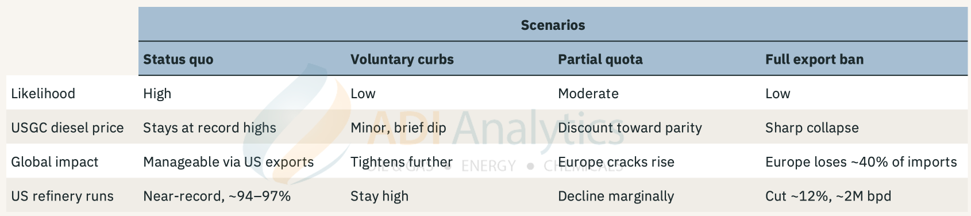
Exhibit 1.
The export-ban debate will continue to evolve in the coming weeks and months. What is arguably more interesting, however, is where the effects of diesel tightness are already appearing across the broader industrial economy. The answer increasingly points to refinery operations, lubricant supply, freight networks, renewable fuel feedstocks, and refining investment decisions. ADI’s long-term global diesel demand forecast provides broader context on the freight, industrial, agricultural, construction, mining, and backup-power uses that continue to support diesel demand.
Refining capacity is gaining strategic value
Refiners are operating in one of the strongest margin environments in years. U.S. refinery utilization has ranged between 94% and 98%, and diesel cracks have exceeded $100 per barrel in several markets. These conditions extend the product scarcity and regional divergence highlighted in ADI’s 2026 global refining and fuels outlook.
Those economics are influencing operating decisions. TotalEnergies pushed a planned turnaround at its Normandy refinery from November 2026 into 2027. Similar decisions are appearing across the industry as refiners prioritize production during a period of unusually strong diesel margins.
Diesel production is tightening lubricant supply
One of the less discussed consequences of current diesel economics is the impact on lubricant markets.
Refiners are directing feedstocks such as vacuum gas oil into diesel production because diesel margins currently exceed returns from premium base oil manufacture. Spot availability for Group III base oils has tightened as a result, leaving fewer barrels available to lubricant formulators.
Lubricants and diesel compete for many of the same refinery streams. A market that rewards diesel production inevitably affects lubricant availability. The impact is beginning to appear in lubricant supply chains and selected specialty chemical markets that depend on those products.
Freight networks are adapting to higher diesel costs
Higher diesel prices are influencing how goods move.
Rail is becoming more attractive as diesel costs rise, contributing to a 5.4% increase in U.S. rail intermodal traffic through September 2026. Trucking remains essential for large portions of the freight market, though higher fuel costs continue to move through fuel surcharges and freight contracts. ADI’s analysis of how global diesel markets are leaning more on North America shows why reliable exports from the region are becoming more important to freight and industrial activity.
Infrastructure constraints are becoming more visible as well. Additional diesel supply on the Gulf Coast does not automatically translate into relief elsewhere because key pipelines are already heavily utilized.
Companies are also making longer-term adjustments. FedEx recently ordered 2,000 electric medium-duty trucks as part of a broader effort to reduce exposure to fuel-price volatility.
Feedstock availability is limiting renewable diesel growth
Higher diesel prices improve renewable diesel economics and support higher operating rates. U.S. biomass-based diesel production increased 18.4% year over year during the first eight months of 2026.
Feedstocks remain the primary constraint though.
Soybean oil prices reached approximately $0.70 per pound during the third quarter of 2026, and biofuels now account for roughly half of U.S. soybean oil consumption. Renewable diesel, biodiesel, and sustainable aviation fuel producers are competing for the same pool of soybean oil, tallow, animal fats, corn oil, and used cooking oil. ADI’s review of biofuels in a tight 2026-2027 RFS market explains why higher mandated volumes are increasing pressure on domestic liquid biofuels and feedstock availability.
Renewable diesel capacity is expanding faster than the supply of feedstocks available to support it. The growth challenge is increasingly shifting upstream into agricultural and waste-based feedstock markets.
Countries are revisiting refining self-sufficiency
Countries that depend heavily on imported fuels are paying greater attention to domestic refining capability and diesel security.
Argentina recently completed a new diesel hydrotreating unit at its Luján de Cuyo refinery and reduced gasoline and diesel imports to zero during the second quarter of 2026. Petrobras is evaluating projects that would increase production of low-sulfur diesel from existing refinery assets.
China has become an increasingly important variable in global diesel markets. Although the country has refining capacity available, exports remain governed by domestic inventory levels and government policy. Recent decisions to suspend fuel exports to preserve local inventories underscore how quickly diesel trade flows can shift when supply security becomes a priority.
China has become an increasingly important variable in global diesel markets. Although the country has refining capacity available, exports remain governed by domestic inventory levels and government policy. Recent decisions to suspend fuel exports to preserve local inventories underscore how quickly diesel trade flows can shift when supply security becomes a priority.
Refining capacity, freight infrastructure, agricultural feedstocks, and product trade flows are becoming increasingly important determinants of industrial competitiveness. Companies that depend on diesel need to understand more than fuel prices. Refinery access, logistics constraints, feedstock availability, and evolving trade patterns are increasingly shaping operating costs, supply reliability, and investment decisions. These issues sit at the center of ADI’s work across refining and fuels markets, assets, technologies, and transactions.
About ADI Analytics
ADI is a prestigious, boutique consulting firm specializing in oil and gas, energy, and chemicals since 2009. We bring deep expertise in a broad range of markets where we support Fortune 500, mid-sized and early-stage companies, and investors with consulting services, research reports, and data and analytics, with the goal of delivering actionable outcomes to help our clients achieve tangible results.
We also host the ADI Forum that brings c-suite executives together for meaningful dialogue and strategic insights across the oil & gas, energy transition, and chemicals value chains. Learn more about the ADI Forum.
Subscribe to our newsletter or contact us to learn more.