Venture Global’s LNG projects have drawn attention for how quickly they have moved from construction to first production. A highly modular, repeatable design approach has allowed those projects to come online faster than many traditional, bespoke developments.
Across energy and industrial markets, project conditions have become more challenging. Project costs are rising and timelines are slipping. Labor is tight. Materials are volatile. Supply chains remain uneven. Together, these conditions are pushing companies to rethink project design to reduce exposure to on‑site labor, simplify execution, and shorten timelines. Modular approaches, like those used by Venture Global, are gaining momentum as companies look for more predictable ways to bring projects online.
Project economics under pressure
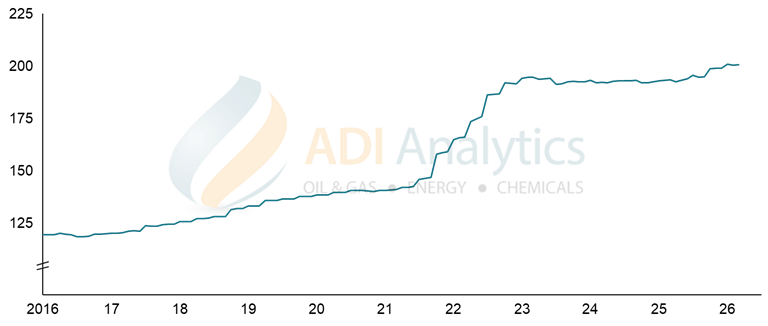
Cost inflation has changed the math of project development. Industrial construction costs are well above pre-2020 levels (Exhibit 1). Skilled labor remains scarce across major industrial hubs, with the U.S. construction industry facing a shortfall of roughly 400,000–500,000 workers annually in recent years. At the same time, higher interest rates have raised the cost of carrying projects that arrive late.
Delays now carry a larger penalty than in prior cycles. Each month of slippage can compound EPC costs, extend financing exposure, and push revenue further into the future. In capital-intensive projects, these effects stack quickly, turning modest delays into material value erosion. As a result, execution risk has moved to the center of investment decisions.
In this environment, predictability matters more than ever. Owners and investors increasingly value downside protection alongside headline returns, particularly when cost inflation and demand uncertainty remain elevated. Reducing variability has become a core objective of project design, often proving more valuable than optimizing for best-case outcomes.
Big builds, big problems
These pressures are especially acute for large, bespoke projects. Mega-projects concentrate capital, schedule, and execution risk into a single decision. Once construction begins, their size and complexity make course correction difficult.
Long development timelines mean increased exposure to labor shortages, cost inflation, and shifting market conditions. In recent years, a number of large, capital-intensive projects across LNG, chemicals, and refining have faced delays, cost overruns, or scope changes. In many cases, these outcomes reflect overlapping pressures, from labor shortages and EPC bottlenecks to supply chain disruptions, permitting delays, and shifts in demand or pricing.
When setbacks occur at this scale, the impact on returns is amplified. Cost overruns compound quickly, schedules slip further, and flexibility is limited once construction is underway. For many companies, these dynamics have made all‑at‑once mega‑projects less attractive in today’s high‑cost, high‑uncertainty environment.
Why modular makes sense
Modular and standardized designs offer a different risk profile, in part by shifting more work off‑site into factories and fabrication yards. By relying less on on‑site construction labor, these designs reduce exposure to labor shortages, weather disruptions, and site‑level productivity challenges. More work is completed in controlled settings, where schedules are easier to manage and quality can be replicated from one unit to the next.
Venture Global’s LNG projects illustrate how this approach can translate into faster execution. By deploying a highly modular, repeatable design and standardizing major components across projects, Venture Global has been able to compress construction timelines and reach initial production more quickly than more traditional LNG projects. The emphasis on repetition and pre‑fabrication reduces rework, shortens learning curves, and allows subsequent units to be delivered more efficiently.
Standardization also simplifies engineering. Fewer custom elements mean shorter design cycles and fewer late‑stage changes once construction is underway. Over time, repeating similar designs allows contractors and operators to learn faster, make fewer mistakes, and keep costs and schedules tighter from one project to the next.
Just as important, modular designs enable phasing. Capital can be committed in smaller increments, with additional units added only as demand becomes clearer. This approach gives companies more flexibility to pause, adjust, or expand projects, reducing downside risk if market conditions change. These dynamics are increasingly visible across sectors. LNG developers are favoring repeatable trains and phased expansions over single, oversized builds. Chemical producers are leaning toward modular debottlenecking and bolt‑on units rather than new world‑scale complexes. Many energy transition projects rely on skid‑mounted, factory‑assembled systems to manage cost and labor risk.
Implications for capital allocation
Taken together, these trends help explain why modular project designs are becoming more common. Rising costs and execution risk are already changing how companies decide where to invest, making large, all‑at‑once projects with limited flexibility harder to justify.
Recent disruptions to global LNG supply reinforce the value of speed and flexibility. At QatarEnergy’s Ras Laffan complex, damage to LNG facilities has taken an estimated 12.8 million tons per year of capacity out of service. Given Qatar’s role as one of the world’s largest LNG exporters and repair timelines of three to five years, global LNG balances have materially tightened. This has increased the strategic value of replacement capacity that can come online quickly. In this context, modular LNG designs offer a potential pathway for developers to advance new capacity on shorter timelines while longer‑cycle projects remain under repair or development.
In an environment defined by uncertainty, modular and standardized designs are changing the range of options available to developers. Instead of committing capital all at once and hoping assumptions hold, companies can stage investments, respond to shifts in supply and demand, and adjust project scope as conditions evolve. In markets where uncertainty is persistent rather than cyclical, that ability to preserve options is becoming a valuable asset.
— Piercen Hoekstra
About ADI Analytics
ADI is a prestigious, boutique consulting firm specializing in oil and gas, energy, and chemicals since 2009. We bring deep expertise in a broad range of markets where we support Fortune 500, mid-sized and early-stage companies, and investors with consulting services, research reports, and data and analytics, with the goal of delivering actionable outcomes to help our clients achieve tangible results.
We also host the ADI Forum that brings c-suite executives together for meaningful dialogue and strategic insights across the oil & gas, energy transition, and chemicals value chains. Learn more about the ADI Forum.
Subscribe to our newsletter or contact us to learn more.