Going blue: How CCS is growing across the oil and gas value chain
Leading operators such as Chevron, ExxonMobil, and Phillips 66 have announced CCS projects across the oil & gas value chain.
A techno-economic analysis (TEA) is a very useful tool to evaluate the economic performance of an industrial process or product. The TEA can be used to study the impacts of implementing a new technology into a current process, optimize existing processes, or to evaluate the economic feasibility of a process before an investment is made. […]
Energy transition is driving new interest in biofuels. Hydrothermal liquefaction is an interesting pathway although it needs further development.
The global shipping industry is one of the hard-to-abate industries when it comes to decarbonization. While it constitutes a small share of global CO2 emissions today, it may see astronomical amount of growth if left unchecked. Global shipping industry demand is expected to see a 275% increase by 2050 compared to 2020 levels. To address […]
Amid the global shift away from coal-fired power, the coal industry is attempting to find its place in a new ESG-focused world.
Eagle Ford natural gas production is increasing, but what is driving the growth? Also, a look at what top operators are doing to reduce GHG emissions.
With carbon capture becoming more prevalent in today’s world, CO2 conversion is becoming one of the popular utilization methods for the captured emissions.
Since 2019, midstream companies have been lowering their capital spending annually. For example, Kinder Morgan expects to spend roughly $390 million less in capex in 2022 than they did in 2019, as seen in Exhibit 1. This trend for companies in the industry is due to a multitude of factors which were covered in depth […]
Growing ESG pressure from investors, rise in public awareness towards climate change, and countries setting ambitious net-zero emission targets have motivated upstream operators to invest in technologies that can reduce their carbon footprint. What are the operators doing to reduce flaring?
ADI Analytics along with the U.S. Energy Association and Gas Technology Institute explored the opportunities for U.S.-based small-scale liquefied natural gas (LNG) in Central and Eastern Europe for the U.S. Department of Energy in 2020. While decarbonization, energy security, and supply diversification were identified as the key drivers of U.S.-based small-scale LNG adoption in the […]
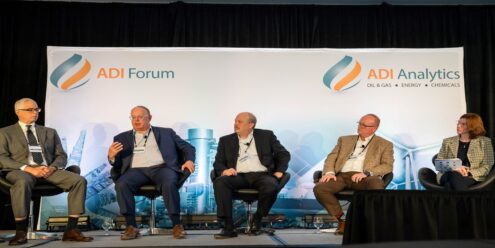
Since 2017, the ADI Forum had been a vital event for oil and gas professionals seeking networking opportunities and fresh perspectives. Featuring insights from leaders such as Fabio Ribeiro, Director at CISTAR; Terry Shidner, Enterprise Account Executive at AlphaSense; Reinaldo Bermudez, Executive Director of Turbomachinery Sales at MAN Energy Solutions; Vincent Follaca, Senior Business Development […]
At the 2022 ADI Forum, Aaron Ketter, VP of the Mid-Continent and South Texas Business Unit at Devon Energy, shared insights into the upstream sector’s opportunities and challenges. His discussion highlighted how the industry is navigating a complex landscape during ADI’s annual oil and gas conference. With commodity prices surging in recent years, the oil […]