As ADI discussed recently in Trends shaping the U.S. midstream outlook, rising LNG exports, growing power demand from AI data centers, and continued oil and gas production growth are driving a new wave of midstream investment. Much of the industry’s recent focus has been on relieving Permian gas takeaway constraints through projects such as Kinder Morgan’s GCX expansion, WhiteWater’s Blackcomb pipeline, and Energy Transfer’s Hugh Brinson project, which together are adding more than 5 Bcf/d of incremental capacity to move Permian gas toward Gulf Coast markets. This buildout mirrors themes discussed in ADI’s 2026 midstream mid-year trends report and our blog on new takeaway capacity in Permian gas markets.
Yet even as new pipelines come online, the nature of the bottleneck is changing. As seen in exhibit 1, Permian natural gas production grew from 17.2 Bcf/d in 2021 to 27.6 Bcf/d in 2025, a 60% increase that significantly outpaced oil production growth of 39% over the same period. A key driver is the basin’s rising gas-to-oil ratio (GOR), which reached nearly 4,200 cubic feet per barrel in 2025, up 16% from 2021. As reservoirs mature and associated gas volumes continue increasing, Permian gas production could reach 29.5 Bcf/d in 2026, reinforcing the need for additional gas gathering and processing infrastructure.
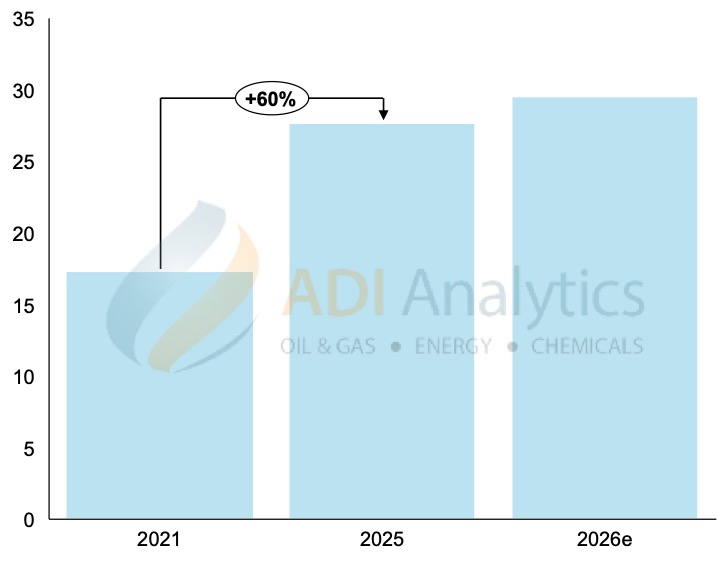
Exhibit 1. Permian natural gas production in billion cubic feet per day. Source: U.S. EIA, ADI
Midstream operators are already responding. In August, Targa Resources announced three new gas processing plants in the Delaware Basin and indicated it is evaluating up to five additional facilities to support future growth. More broadly, roughly 3.7 Bcf/d of Permian gas processing capacity is expected to be added between 2024 and 2026, including ~2.4 Bcf/d in the Delaware Basin.
The challenge is that takeaway capacity, processing capacity, and gathering infrastructure are not always expanding in sync. Much of the new processing infrastructure is concentrated in the northern Delaware Basin, while major interstate pipelines originate around Waha. As a result, gathering systems, compression assets, and intra-basin connector pipelines are becoming increasingly important for moving gas from producing areas to processing centers and long-haul transportation networks, making basin connectivity, rather than takeaway capacity alone, the next emerging constraint.
For operators, investors, equipment suppliers, and service providers, this shift expands the opportunity set beyond large interstate pipelines. As ADI noted in our prior blog on the next wave of energy infrastructure deals, investment is expected to increasingly flowing toward gathering systems, gas processing plants, compression stations, connector pipelines, and other assets that improve basin-wide connectivity.
Identifying where infrastructure is being built, where capacity gaps remain, and how production growth is evolving will be critical to capturing the next wave of midstream opportunities. ADI supports clients through project tracking, infrastructure intelligence, capacity forecasting, and market analysis across the upstream, midstream, LNG, and power value chains. Readers interested in broader infrastructure and demand trends can also explore our notes from the Gas to Grid Summit and how water limits are reshaping oil & gas, power, and chemical operations.
– Panuswee Dwivedi
About ADI Analytics
ADI is a prestigious, boutique consulting firm specializing in oil and gas, energy, and chemicals since 2009. We bring deep expertise in a broad range of markets where we support Fortune 500, mid-sized and early-stage companies, and investors with consulting services, research reports, and data and analytics, with the goal of delivering actionable outcomes to help our clients achieve tangible results.
We also host the ADI Forum that brings c-suite executives together for meaningful dialogue and strategic insights across the oil & gas, energy transition, and chemicals value chains. Learn more about the ADI Forum.
Subscribe to our newsletter or contact us to learn more.