On October 26, 2026, EQT Corporation agreed to buy Range Resources, both Appalachian gas producers, in an all-stock deal valued at $13.84 billion. The combined company produces over 9 billion cubic feet of gas equivalent per day (Bcfe/d), the most of any U.S. gas producer.
ADI Analytics’ analysis of how this might impact the outlook for U.S. natural gas prices suggests a potentially higher floor for Appalachian prices although our Henry Hub forecast of $3.50–$3.75 per MMBtu is unchanged through 2030. Five findings support that view, and Exhibit 1 summarizes our assessment.
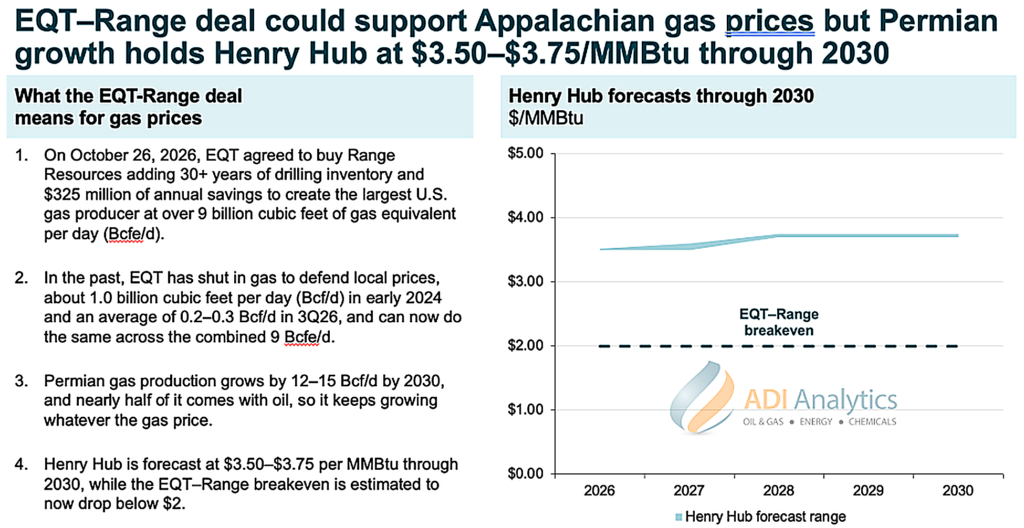
Exhibit 1: What the EQT–Range deal means for gas prices.
1. EQT now controls curtailment across 9 Bcfe/d
EQT shut in about 1.0 billion cubic feet per day (Bcf/d) in early 2024. In 3Q26 it shut in 20–25 Bcfe, an average of 0.2–0.3 Bcf/d, after the Southwest Appalachia differential widened beyond ($1.00)/MMBtu. Range did not curtail before the deal, and EQT can now apply the same practice to Range’s acreage.
2. Permian supply grows by 12–15 Bcf/d by 2030
Forecasts include a rise from about 30 Bcf/d in mid-2026 to about 43 Bcf/d with flat oil drilling. Nearly half of Permian gas is associated with oil, so its supply responds little to gas prices. The growth is 12 to 15 times EQT’s largest shut-in. ADI’s midstream outlook projects U.S. and North American gas production growth of 1.4–2.7% a year through 2030.
3. Pipeline bottlenecks limit Permian gas reaching Gulf Coast LNG terminals
Bottlenecks between the Houston Ship Channel and the Sabine River liquefied natural gas (LNG) corridor limit direct Permian pipeline connections to Gulf Coast terminals. This preserves a geographic and commercial advantage for Haynesville and Appalachian producers.
4. EQT–Range breaks even below $2/MMBtu
EQT–Range’s unlevered free cash flow breakeven is below $2/MMBtu. A price of about $5/MMBtu is needed to bring on higher-cost dry-gas supply. At $3.50–$3.75, EQT–Range earns $1.50 or more above breakeven and higher-cost basins stay below their response price.
5. LNG and power demand grows through 2030
Utility sales of 1.2 Bcf/d on the Mountain Valley Pipeline (MVP) start in 2027. EQT’s 4.5 million tons per annum of LNG contracts start in 2030–31, and a 325 million cubic feet per day contract with a West Virginia power plant starts as early as 2031.
U.S. gas supply outruns the first wave of LNG export capacity through 2028. ADI’s LNG export terminals database expects U.S. LNG export capacity to grow to more than 160 million tons per annum by 2030, and ADI’s data center projects database projects about 115 GW of new U.S. data center capacity by 2030.
More consolidation among gas-weighted producers is expected. Likely sellers are assets that owners treat as non-core, such as utility-owned upstream units being separated into public companies, Haynesville positions, and private Utica and Marcellus operators. ADI Analytics assesses these transactions through basin-level supply forecasts, breakeven cost analysis, and diligence on inventory and midstream access, and quantifies what each deal means for regional gas prices.
About ADI Analytics
ADI is a prestigious, boutique consulting firm specializing in oil and gas, energy, and chemicals since 2009. We bring deep expertise in a broad range of markets where we support Fortune 500, mid-sized and early-stage companies, and investors with consulting services, research reports, and data and analytics, with the goal of delivering actionable outcomes to help our clients achieve tangible results.
We also host the ADI Forum that brings c-suite executives together for meaningful dialogue and strategic insights across the oil & gas, energy transition, and chemicals value chains. Learn more about the ADI Forum.
Subscribe to our newsletter or contact us to learn more.