Ammonia has increasingly emerged as a potential low-carbon marine fuel to support decarbonization in the maritime sector due to its carbon-free combustion profile. However, compared to methanol, ammonia has lagged behind in commercial adoption as a low-carbon marine fuel. This is primarily due to its toxicity, which requires more complex storage and handling systems, as well as limited regulatory clarity that has slowed technology and equipment development.
In a recent milestone, the International Maritime Organization (IMO) approved new safety guidelines for ammonia-fueled ships. Developed in collaboration with industry stakeholders, the guidelines aim to reduce regulatory uncertainty by establishing a framework for the safe storage, handling, and operation of ammonia onboard to support the broader commercialization of ammonia-fueled vessels.
Based on ADI’s experience across the chemicals and energy sectors, including advisory work for ammonia producers, shipowners, and technology providers, here are three key implications for ammonia and broader value chain following the IMO’s recent update:
1. The maritime sector could drive a new wave of demand growth for ammonia
The regulatory green light is expected to support a structural shift in global ammonia demand beyond fertilizers and industrial uses. A massive pipeline of low-carbon ammonia projects is underway in the U.S. to support future maritime and power sector demand. Major blue ammonia projects include the Blue Point JV by CF Industries, JERA, and Mitsui, which targets 1.4 million tonnes per annum (mtpa) of production capacity by 2029, and the Louisiana Energy Complex by Air Products and Yara, which is expected to add 2.8 mtpa of production capacity by 2030. ADI’s global blue ammonia projects database offers comprehensive intelligence on blue ammonia projects worldwide, including production capacity, project type, development status, expected start-up timelines, and key partners. The database supports informed decision-making for ammonia producers, project developers, technology providers, investors, and other stakeholders across the value chain, and is available exclusively to ADI Plus Enterprise subscribers.
Investments are also expanding globally across carbon capture and hydrogen infrastructure to support low-carbon ammonia production. Notably, the NEOM Green Hydrogen project in Saudi Arabia, which is expected to help establish the green ammonia supply base needed for wider shipping adoption by the late 2020s.
2. IMO’s new safety guidelines could support the development of ammonia-fueled vessels, and early movers would benefit as adoption increases
The IMO’s new safety guidelines also help simplify vessel compliance requirements and provide greater technical and legal certainty for shipowners, engine developers, and other stakeholders evaluating ammonia-fueled vessel investments. Companies have already accelerated investments in ammonia-compatible engines, vessel retrofits, and relevant infrastructure. Wärtsilä has launched the first commercial 4-stroke ammonia engine, capable of reducing greenhouse gas emissions by up to 90%, while shipping companies like North Sea Container Line have invested in ammonia-fueled container ships built by CMB.TECH for routes between Norway and Germany.
According to the Ammonia Energy Association, only five ammonia-fueled vessels currently operate globally, but the fleet could grow to around 200 vessels by 2033 based on announced and ordered ammonia-capable ships (see Exhibit 1). Broader commercialization could also drive investment in storage terminals and export infrastructure. Companies such as Navigator Holdings are investing in ammonia bunkering infrastructure through projects like Azane Fuel Solutions to support future fuel availability. As regulatory clarity improves and shipping companies increasingly evaluate future fuel strategies, early movers across the marine engine and shipping value chain could benefit from rising demand.
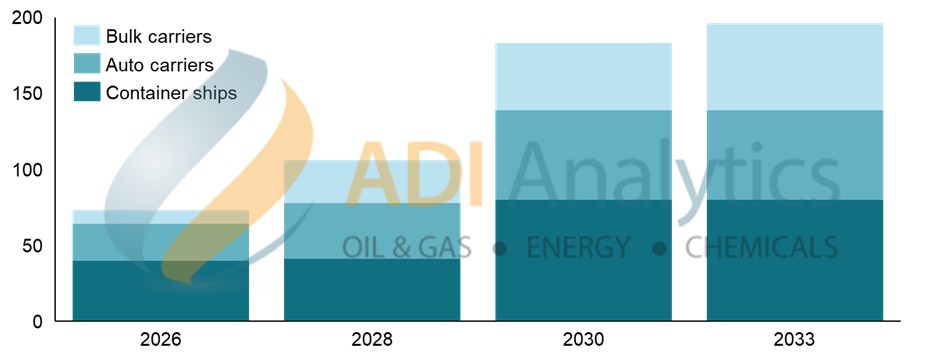
Exhibit 1: Estimated ammonia-capable vessel demand by ship type through 2033. (Source: Ammonia Energy Association, ADI)
3. Growing ammonia fuel adoption could reshape chemical markets
Existing ammonia supply is already facing periodic disruptions and tightening market conditions, partly due to geopolitical factors such as the Iran conflict. Additional demand from shipping could further strain global nitrogen balances over time.
Increased ammonia fuel adoption may also drive demand for catalysts and emissions-control technologies, including selective catalytic reduction (SCR) systems used to manage NOx emissions. ADI has supported several engagements assessing the exhaust gas treatment market across both catalytic and non-catalytic technologies.
While ammonia still faces challenges around supply availability and cost competitiveness compared to conventional marine fuel oils, the IMO’s latest guidelines mark an important step toward broader commercialization. As regulatory clarity improves and investment continues to scale across the value chain, ammonia could become a viable low-carbon marine fuel over the coming decades.
Contact ADI Analytics to explore how our market intelligence and experience can help you navigate evolving ammonia market dynamics, maritime decarbonization trends, and low-carbon fuel strategy initiatives.
– Edmund Lam
About ADI Analytics
ADI is a prestigious, boutique consulting firm specializing in oil and gas, energy, and chemicals since 2009. We bring deep expertise in a broad range of markets where we support Fortune 500, mid-sized and early-stage companies, and investors with consulting services, research reports, and data and analytics, with the goal of delivering actionable outcomes to help our clients achieve tangible results.
We also host the ADI Forum that brings c-suite executives together for meaningful dialogue and strategic insights across the oil & gas, energy transition, and chemicals value chains. Learn more about the ADI Forum.
Subscribe to our newsletter or contact us to learn more.