Analysts have been quick to predict permanently altered LNG trade flows, structurally different chemical markets, and a new global energy order following the Iran conflict. Several months into the conflict, the evidence points to a narrower set of lasting impacts than many early forecasts suggested.
1. The LNG market adapted faster than expected
LNG was arguably the market most exposed to the conflict. The International Energy Agency estimates the conflict could remove roughly 140 bcm of LNG supply between 2026 and 2030 due to Hormuz disruptions, damage to Qatari LNG facilities, and delays to planned expansions. Iranian strikes on Ras Laffan reportedly eliminated 15-20% of Qatar’s LNG capacity, with repairs expected to take three to five years.
The immediate impact associated with Hormuz disruptions was closer to 35 bcm. Roughly two-thirds of those Hormuz-related LNG losses were offset by new LNG supply from North America and Africa, higher pipeline imports, and demand adjustments (see Exhibit 1). Global LNG trade is expected to remain broadly flat in 2026 notwithstanding these disruptions.
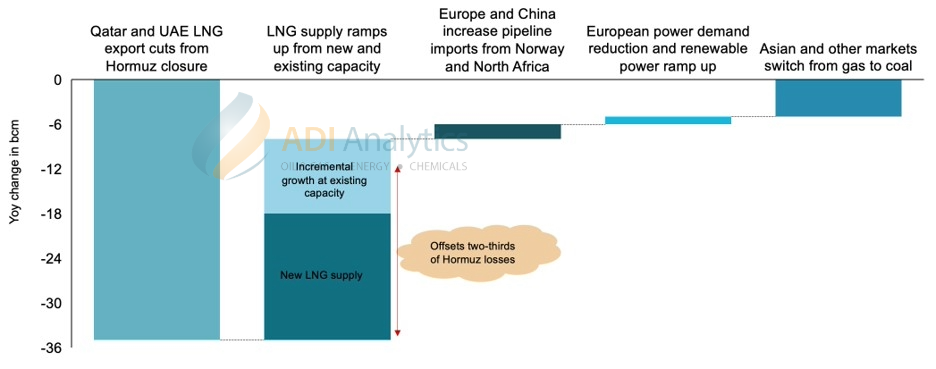
Exhibit 1. Supply-demand balance following LNG disruption from the Middle East conflict during March-June 2026 (Source: IEA, ADI).
2. Commodity markets are reverting to fundamentals
Polyethylene prices have already fallen roughly 15-20% from their April peaks. U.S. polyethylene prices gave back 10 c/lb in July after increasing roughly 40 c/lb during March and April. Urea prices have largely returned to pre-conflict levels, falling by nearly half from their April peak.
Buyers that initially rushed to secure supply have become more selective. Chemical producers still face excess capacity, and global polyethylene utilization rates are projected to fall toward 75% by 2028 as new capacity additions continue to outpace demand growth.
3. The Middle East remains central to global energy supply
Utilities, LNG importers, and industrial buyers are all exploring the addition of new supply options.
Even so, Qatar remains one of the world’s lowest-cost LNG suppliers, with production costs estimated around $0.50/MMBtu compared with a global average of $3-5/MMBtu. Gulf producers remain among the world’s lowest-cost oil producers, and Saudi Arabia and the UAE retain significant ability to increase production over time.
Those cost advantages remain intact. Middle Eastern producers are likely to remain core suppliers even as buyers add flexibility and broaden their portfolios.
4. Energy security is driving infrastructure spending
Saudi Arabia’s East-West pipeline operated at its full 7 million b/d capacity during the conflict, and the Kingdom is evaluating a further 1-2 million b/d expansion. The UAE is expanding export flexibility through Fujairah and pursuing additional Hormuz bypass capacity, including a second crude pipeline. Strategic storage projects are also being evaluated in locations including Fujairah and Mangalore.
Regional investment in pipelines, ports, storage, and related infrastructure is expected to reach tens of billions of dollars as governments and companies build redundancy into energy supply systems.
China is also increasing investments tied to feedstock security. Coal-to-olefins facilities reportedly operated at roughly 95% utilization during the disruption, compared with 70-74% for some naphtha-based assets facing feedstock constraints. Chinese developers are evaluating larger-scale coal-to-olefins projects designed to reduce reliance on imported feedstocks.
Bottom line
We can see lasting impacts across infrastructure, storage, and feedstock sourcing strategies. On the other hand, LNG markets absorbed a large portion of lost supply, commodity prices have retraced, and industry cost curves remain largely unchanged. The range of lasting impacts appears narrower than many early forecasts suggested.
– Uday Turaga
About ADI Analytics
ADI is a prestigious, boutique consulting firm specializing in oil and gas, energy, and chemicals since 2009. We bring deep expertise in a broad range of markets where we support Fortune 500, mid-sized and early-stage companies, and investors with consulting services, research reports, and data and analytics, with the goal of delivering actionable outcomes to help our clients achieve tangible results.
We also host the ADI Forum that brings c-suite executives together for meaningful dialogue and strategic insights across the oil & gas, energy transition, and chemicals value chains. Learn more about the ADI Forum.
Subscribe to our newsletter or contact us to learn more.