ADI Analytics has updated its long-term global oil demand outlook, providing a fresh perspective on how economic growth, energy transition policies, technology adoption, and shifting regional demand patterns will shape oil consumption through 2050. Exhibit 1. below shows macroeconomic assumptions for our scenarios. Despite continued growth in electric vehicles and low-carbon fuels, our analysis suggests that global oil demand continues to rise over the next quarter century, supported by expanding petrochemical production, aviation growth, and rising energy consumption in emerging economies.
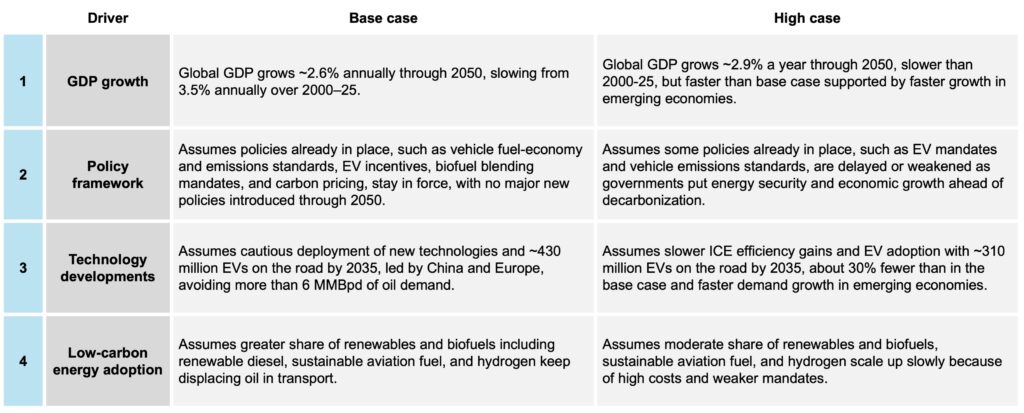
Exhibit 1. Scenario assumptions driving ADI’s long-term global oil demand outlook. Source: IMF, IEA, OPEC, ADI
ADI Plus subscribers can access our detailed oil demand forecasts by region, providing both short-term outlooks and long-term projections extending up to 2050. Enhanced subscribers also get a downloadable PDF of ADI’s global oil demand forecasts segmented by region through 2050. For Enterprise subscribers, an additional data file is also available.
Key takeaways
- Global oil demand continues to grow through mid-century in both scenarios, although at a slower pace than historical averages. Neither outlook indicates a peak in demand before 2050.
- Electrification of road transport remains the most significant headwind to oil demand growth. However, adoption rates vary considerably across scenarios, creating meaningful differences in long-term consumption levels.
- Petrochemicals and aviation emerge as the primary sources of incremental demand, more than offsetting declines in traditional road fuel consumption.
- Demand growth increasingly shifts toward emerging economies, particularly in Asia Pacific, Africa, and the Middle East, where rising populations, industrialization, urbanization, and mobility continue to support oil consumption growth.
- Europe is expected to see the steepest decline in oil demand among major regions as vehicle electrification, efficiency improvements, and decarbonization policies accelerate. North American demand remains comparatively resilient but largely flat over the long term.
- The long-term outlook remains highly dependent on assumptions around economic growth, technology adoption, and energy transition policies. While some forecasters anticipate demand peaking within the next decade, others continue to see sustained growth through 2050 and beyond.
The outlook points to a more gradual energy transition than many headlines suggest. While electrification will increasingly erode demand for transportation fuels, continued growth in petrochemicals, aviation, and emerging markets is expected to keep global oil demand on an upward trajectory for decades to come.
ADI Plus subscribers can access our detailed oil demand forecasts by region, providing both short-term outlooks and long-term projections extending up to 2050. Enhanced subscribers also get a downloadable PDF of ADI’s global oil demand forecasts segmented by region through 2050. For Enterprise subscribers, an additional data file is also available.
Log in or subscribe to unlock ADI Plus content >>
Have questions? We're happy to help.
About ADI Analytics
ADI is a prestigious, boutique consulting firm specializing in oil and gas, energy, and chemicals since 2009. We bring deep expertise in a broad range of markets where we support Fortune 500, mid-sized and early-stage companies, and investors with consulting services, research reports, and data and analytics, with the goal of delivering actionable outcomes to help our clients achieve tangible results.
We also host the ADI Forum that brings c-suite executives together for meaningful dialogue and strategic insights across the oil & gas, energy transition, and chemicals value chains. Learn more about the ADI Forum.
Subscribe to our newsletter or contact us to learn more.