ADI has released its long-term global natural gas demand outlook, providing a fresh perspective on how economic growth, energy policy, technology adoption, and shifting regional demand patterns will shape gas consumption through 2050. Exhibit 1 below shows the assumptions behind our scenarios. Despite continued growth in renewables and electrification, our analysis suggests that global gas demand keeps rising over the next quarter century, supported by rising power demand from data centers, industrial coal-to-gas switching, and rising energy needs in emerging economies.
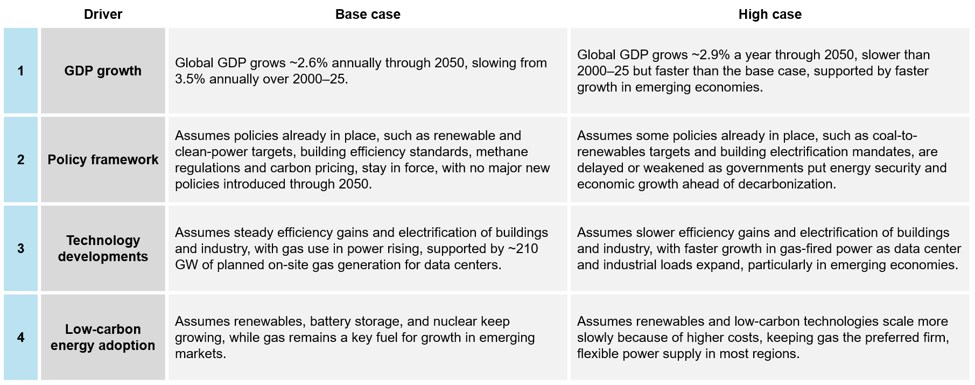
Exhibit 1: Scenario assumptions driving ADI’s long-term global natural gas demand outlook. (Source: IMF, IEA, OPEC, GECF, U.S. EIA, ADI)
ADI Plus subscribers can access our detailed natural gas demand forecasts by region, providing both short-term outlooks and long-term projections extending up to 2050. Enhanced subscribers also get a downloadable PDF of ADI’s global natural gas demand forecasts segmented by region and sector through 2050. For Enterprise subscribers, an additional data file is also available.
Key takeaways
- Global natural gas demand continues to grow through mid-century in both scenarios, although at a slower pace than over the past decade. Neither outlook indicates a peak in demand before 2050.
- Power generation and industry are the primary sources of incremental demand, together accounting for about three-quarters of growth. Gas remains key to balancing power grids with growing shares of renewables, and data centers are expected to drive about 30% of the growth in gas use for power.
- In developed economies, gas demand is held back mainly by growing shares of renewables, electric heating replacing gas heating, and improvements in energy efficiency.
- Recent supply disruptions are pushing some countries that rely on imported gas to speed up the growth of renewables and electrification to improve their energy security, which could limit gas demand growth in key LNG-importing markets.
- Demand growth increasingly shifts toward emerging economies, particularly in Asia-Pacific and the Middle East and Africa, where industrialization, rising electricity demand, and switching from coal and oil continue to support gas consumption.
- Europe’s gas demand is expected to remain broadly stable at best as electrification and efficiency improvements accelerate, while North American demand grows modestly.
The outlook suggests natural gas will play a lasting role in the global energy mix, rather than serving only as a short-term bridge fuel. While renewables and electrification will increasingly limit gas use in developed economies, continued growth in power generation, industry, and emerging markets is expected to keep global gas demand on an upward trajectory through 2050.
ADI Plus subscribers can access our detailed natural gas demand forecasts by region, providing both short-term outlooks and long-term projections extending up to 2050. Enhanced subscribers also get a downloadable PDF of ADI’s global natural gas demand forecasts segmented by region and sector through 2050. For Enterprise subscribers, an additional data file is also available.
Log in or subscribe to unlock ADI Plus content >>
Have questions? We're happy to help.
About ADI Analytics
ADI is a prestigious, boutique consulting firm specializing in oil and gas, energy, and chemicals since 2009. We bring deep expertise in a broad range of markets where we support Fortune 500, mid-sized and early-stage companies, and investors with consulting services, research reports, and data and analytics, with the goal of delivering actionable outcomes to help our clients achieve tangible results.
We also host the ADI Forum that brings c-suite executives together for meaningful dialogue and strategic insights across the oil & gas, energy transition, and chemicals value chains. Learn more about the ADI Forum.
Subscribe to our newsletter or contact us to learn more.